Showing posts with label Asia. Show all posts

Wednesday, 17 April 2013

WORLD ECONOMIC OUTLOOK 2013 - Hope, Reality and Risks

World Economic and Financial Surveys :

World Economic Outlook (WEO) "Hopes, Realities, and Risks"

April 2013 : Global economic prospects have improved again, but the bumpy recovery and skewed macroeconomic policy mix in advanced economies are complicating policymaking in emerging market economies. 

Chapter 3 examines the prospects for inflation, particularly because inflation was remarkably stable in the wake of the Great Recession and, in fact, has become less responsive to cyclical conditions. 

Chapter 4 examines whether today’s fast-growing, dynamic low-income countries are likely to maintain their momentum and avoid the reversals that afflicted many such countries in the past.


Contents & Front Matter


Chapter 3: The Dog That Didn't Bark: Has Inflation Been Muzzled or Was It Just Sleeping?

 This chapter finds that inflation expectations have remained strongly anchored to inflation targets during the Great Recession and the sluggish recovery. Long-term inflation expectations in advanced economies remain close to targets despite wide variation in actual inflation rates. Even in Japan, expectations remain close to the 1 percent target announced in February 2012 despite a prolonged period of deflation. Furthermore, coincident with greater central bank credibility, this anchoring is found to have increased over time
The chapter compares this recent wave of dynamic LICs with the previous wave, primarily dynamic LICs in the 1960s and 1970s, and finds: Important similarities: Both achieved stronger investment rates and export growth than LICs that were unable to takeoff. Striking differences: Today’s dynamic LICs sustained growth with much lower economic vulnerabilities than dynamic LICs in the past. This reflects in part greater reliance on foreign direct investment than on debt-financed investment, as well as faster implementation of structural reforms.

Statistical Appendix  : Text (Download PDF)

Thursday, 13 October 2011

International Day for Disaster Reduction - 13 October

66.5 million children are affected annually by disasters. Because it is difficult for them to cope with unexpected and painful interruptions to their lives, they are often more affected than adults. Victims of disaster and climate change, children and young people can and should be encouraged to participate in disaster reduction and decision making.


Chair’s summary third session of the Global Platform for Disaster Risk Reduction and the World Reconstruction Conference

 
This summary provides the Chair’s assessment of the main points of the deliberations at the Third Session of the Global Platform for Disaster Risk Reduction held in Geneva, Switzerland from 8-13 May 2011.

The Chair`s Summary reflects interventions at the Joint Outcomes Session of the Global Platform on 13 May and subsequent comments on the draft which was open until 23 May. The UNISDR secretariat has endeavoured to reflect most of the comments while at the same time respecting the need to keep the Summary succinct and action orientated.
Date: 2011
Sources:

Related Links

Keywords

Themes:
Climate Change, Early Warning, Media, Recovery, Risk Identification & Assessment, Urban Risk & Planning, Governance, Economics of DRR, Structural Safety, Vulnerable Populations

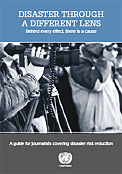
Disaster through a different lens: behind every effect, there is a cause

Behind every effect, there is a cause:

This manual for the media - compiled by journalists and disaster experts who understand that disaster risk reduction is a civic duty, government responsibility, national obligation and a good story - is for reporters and broadcasters who want to know more about those urgent, terrifying and all-too-often tragic moments when the fabric of national and civic government encounters the forces of nature.

It asserts the importance of the role of newspapers, radio, television and other media in creating awareness and disseminating information about disasters. Reporters, commentators and broadcasters, can do more than just inform and raise awareness about disasters. They can make a real difference in the way people think and act, especially now when climate change is recognized as a major challenge that will aggravate our vulnerability to disasters.

The chapters address:

- What you need to know about disaster risk reduction (DRR)
- Disaster risk reduction in the media
- DRR lessons from four disasters: Indian Ocean tsunami; Mt. Pinatubo, Philippines; Hurricane Katrina, USA; Kashmir earthquake, Pakistan
- Useful information on natural hazards
- Disaster risk reduction resources

The conclusion includes: Annexes on a brief history of the evolution of disaster risk reduction, terminology, and how corruption costs lives; a Bibliography.
Date:
2011
Author(s):
Leoni, Brigitte; Radford, Tim; Schulman, Mark
Pages:
188 p.
Sources:

Keywords

Themes:
Capacity Development, Information Management, Media
Hazards:
Cyclone, Drought, Earthquake, Flood, Land Slide, Tornado, Tsunami, Volcano, Wild Fire
Regions:
Africa, Americas, Europe, Asia, Oceania

Monday, 3 October 2011

International Day of Non-Violence 2 October

United Nations Secretary-General's Message for 2011

We mark this year’s International Day of Non-Violence in a world dramatically altered since our last commemoration. The powerful engine behind that wave of change – beginning in Tunisia and then spreading across North Africa, the Middle East and elsewhere – was none other than a non-violent struggle for democracy and human rights.
The individuals – many of them youth – at the helm and heart of these movements toppled long-entrenched governments, delivered a rebuke to those who embrace violence, and emboldened other oppressed peoples to think that the path of non-violence might work for them, too.
There is a heavy risk for those who stare down the barrel of a gun armed only with the knowledge that they have right on their side. But courageous individuals who believe in and use non-violence leave oppressors facing what is for them an unpalatable option – crack down harder or negotiate. The former simply reveals the bankruptcy of the systems they are defending; the latter could well set change in motion. This is why non-violence so often confounds those who face it; this is why non-violence is so powerful.
The United Nations Charter clearly champions a peaceful, non-violent approach as the first recourse – utilizing means such as negotiation, mediation, arbitration and judicial settlement.
When the Security Council has sanctioned the use of coercive measures, as was done earlier this year in Libya and Côte d’Ivoire, it was to protect civilians – and then only as a last resort, in the face of violence.
Our non-violent work to build peaceful, stable societies takes many forms – from promoting values and norms to establishing institutions. The rule of law, sustainable development, building and making peace – these are the elements of the UN agenda for non-violent change. We are striving to intervene early, before tensions escalate, and speedily when they do. We are strengthening our strategic partnerships so we can respond more quickly to crises while supporting national institutions for mediation and dialogue.
This International Day coincides with the anniversary of the birthday of Mahatma Gandhi, leader of India’s historic and non-violent movement for independence. His transformative and transcendent approach had deep roots in India’s past. Some two thousand years earlier, Emperor Ashoka renounced recourse to war and devoted himself to the peaceful development of his society. His idea of peace and non-violence extended to the protection of animals and trees – sustainability before its time.
Others around the world have carried this banner, from Chico Mendes in Brazil to the Reverend Dr. Martin Luther King, Jr. in the United States, from Nelson Mandela in South Africa to Professor Wangari Maathai in Kenya. All of these leaders inspired global movements in which they were joined by countless others who embraced non-violence as a core value and animating principle.
The timeless power of non-violence, which has accomplished so much in the past year alone, has a vital role to play in all countries, including established democracies. On this International Day, let us re-commit to supporting non-violence. Non-violence is not only an effective tactic; it is a strategy and the ultimate vision. Durable ends such as peace can only come through durable means – non-violence.


Ban Ki-moon  

Friday, 8 July 2011

Asia - The Millennium Development Goals Report 2011

Asia records sharp reduction in poverty and steady improvements in health of mothers and children But Southern Asia lags in nutrition, sanitation and gender equality, UN report finds
www.un.org
The deep cuts in poverty are mainly found in Eastern and South-Eastern Asia, where the Millennium Development Goals target of halving extreme poverty has already been met, while progress in Southern Asia has been slow and insufficient to meet the target, according to the Millennium Development Goals.

Millennium Development Goals Report 2011


Global press release: "Major progress towards Millennium Development Goals,
but the most vulnerable are left behind, UN report says"

Regional press releases:
Sub-Saharan Africa, North Africa, Asia, Western Asia, Latin America, Caucasus and Central Asia

UN News Center: "UN reports progress towards poverty alleviation, urges increased support for the poorest"