FORUM: ‘‘Prevent, Control, Care: Everyone’s role in Chagas disease.“ World Chagas Disease 2025. In 2025 we are shining a spotlight on Chagas disease, the suffering it causes and are calling for equitable access to health care and services for everyone affected by the disease. Chagas disease is prevalent among poor populations of continental Latin America but is increasingly being detected in other countries and continents. It is often termed as a “silent and silenced disease” as the majority of infected people have no symptoms or very mild symptoms. There are approximately 6-7 million people infected with Chagas disease worldwide, with 10,000 deaths, every year. Early detection is key as Chagas disease is curable when treatment is provided soon after infection. If this does not happen because of delayed diagnosis, the infection can transform into a life-threatening condition. In this case, adequate care throughout life is essential. Detection, treatment and monitoring of the disease can be carried out at primary health-care level in most cases. To mark the day, let's take action by: Increasing awareness about Chagas disease: Chagas disease, predominantly affecting impoverished populations in Latin America, is increasingly spreading across continents. With 7 million infections globally and significant mortality rates, it poses a substantial public health threat. An estimated 10,000 people die from Chagas disease every year, and over 100 million people are at risk of acquiring the disease. Uniting and acting against Chagas disease: Effective prevention and control of Chagas disease requires united, well-trained, and up-to-date health professionals collaborating closely with communities and civil society to address its complex biomedical, social, and environmental challenges. Supporting people with Chagas disease: Promoting initiatives to overcome barriers to healthcare access for marginalized populations affected by the disease, as well as advocating for comprehensive care and support systems will improve outcomes for all affected individuals and their families. Addressing stigma and discrimination: Stigmatization isolates sufferers, hindering timely diagnosis and treatment. Ending stigmatization, discrimination or negligence is essential to ensuring proper care for people with Chagas disease.
EVENTS: The WHO and the PAHO will hold an online event to mark the World Chagas Disease 2025 under the slogan “Prevent, Control, Care: Everyone’s role in Chagas disease.“ the event will seek to give visibility and attention to Chagas and raise the level of awareness in everyone about the importance of improving early detection, expanding diagnostic coverage and equitable access to clinical care for the disease. The WHO Director-General Dr Tedros Adhanom Ghebreyesus calls for global action to end Chagas Disease through prevention, cross-sector collaboration, and equitable access to care.
WEBINARS: On April 14th, 2025, starting at 11:00 am. – US Eastern Time; 12:00 pm. - Argentina 10:00 am. - Colombia; 09:00 a.m. – Mexico and Central America. You are invited to participate to the virtual event, this conversation with people from different sectors, whose contributions and perspectives will seek to enrich and exchange the perceptions and concepts of this problem, beyond the biomedical approach. We will have representatives from the world of cinema, anthropology, journalism and medicine. Join us and help us broaden and expand awareness about this disease to detect it early and give the comprehensive care that affected people need.
Early detection is key as Chagas disease is curable when treatment is provided soon after infection. If this does not happen because of delayed diagnosis, the infection can transform into a life-threatening condition. In this case, adequate care throughout life is essential. Detection, treatment and monitoring of the disease can be carried out at primary health-care level in most cases.
To mark the day, let's take action by
Increasing awareness about Chagas disease: Chagas disease, predominantly affecting impoverished populations in Latin America, is increasingly spreading across continents. With 7 million infections globally and significant mortality rates, it poses a substantial public health threat. An estimated 10,000 people die from Chagas disease every year, and over 100 million people are at risk of acquiring the disease.
Uniting and acting against Chagas disease: Effective prevention and control of Chagas disease requires united, well-trained, and up-to-date health professionals collaborating closely with communities and civil society to address its complex biomedical, social, and environmental challenges.
Supporting people with Chagas disease: Promoting initiatives to overcome barriers to healthcare access for marginalized populations affected by the disease, as well as advocating for comprehensive care and support systems will improve outcomes for all affected individuals and their families.
Addressing stigma and discrimination: Stigmatization isolates sufferers, hindering timely diagnosis and treatment. Ending stigmatization, discrimination or negligence is essential to ensuring proper care for people with Chagas disease.
The role of public, health professionals, communities, patient groups and associations...
Share accurate, evidence-based and updated information about risks associated with Chagas disease.
Talk about Chagas diseases, without pointing to locations or ethnicity of people affected by the disease.
Be empathetic towards people infected with Chagas disease.
The role of Policy makers
Increase investments in capacity and resources towards prevention, diagnosis, management, control, surveillance and screening, starting at primary healthcare level.
Be aware that risk of infection is not limited to areas where bugs are found – transmission can also occur by transfusion of blood and blood products, organ transplantation, congenital routes, oral/foodborne routes and laboratory accident.
Include Chagas disease in policies related to migration and health.
The role of Partners and donors
Advocate for prevention of transmission, early detection, care, epidemiological surveillance, and increased investment, starting at primary healthcare level.
Increase investments and work with governments and local health authorities towards funding access to early diagnosis, safe treatment, care, surveillance and screening, starting at primary care level.
The role of Academia and researchers
More research is needed on quality diagnostics and medicines, and on cost-effective interventions for vector control, hygiene and food safety.
CAMPAIGN: Calling on global leaders and citizens to defeat Chagas disease; Join the campaign!
On April 12, 1961, the world witnessed an event of universal scale (or the universe witnessed an event of global scale) - Soviet cosmonaut Yuri Gagarin on the Vostok-1 spacecraft made the first manned space flight in history, which lasted 108 minutes and opened the era of human exploration of outer space. The Vostok-1 spacecraft was a spherical descent vehicle 4.3 meters long, 2.43 meters in diameter and with a launch weight of 4,725 kilograms. It was equipped with a life support system, automatic control and communications equipment. It was designed for one crew member with a flight duration of up to 10 days. The launch vehicle for the spacecraft was developed on the basis of the two-stage R-7 intercontinental ballistic missile with the addition of a 3rd stage. Its length was 38.2 meters, its diameter was 10.3 meters, and its launch weight was about 287 tons. The rocket could launch a payload of up to 4.5 tons into space. The flight was controlled automatically, but Gagarin had the option to take control if necessary. For safety reasons, the cosmonaut wore a spacesuit during the entire flight. In case of cabin depressurization, the spacesuit contained a four-hour oxygen supply, which protected the cosmonaut when ejecting the seat at an altitude of up to 10 kilometers. The launch took place from the Baikonur Cosmodrome at 9:07 Moscow time. The ship made one orbit around the Earth and landed near the village of Smelovka in the Saratov Region at 10:53. At an altitude of about 7 kilometers, Gagarin ejected from the descent vehicle and landed separately on a parachute. Vostok 1 gave rise to a series of Soviet spacecraft, and even after the completion of the main program, various modifications continued to be used later, serving as the basis for a number of Soviet and Russian satellites. Follow the conversations with the hashtags: #12April, #YuriGargarin, #HumanSpaceFlightDay, #YurisNight, #soyuz.
“Please accept my most sincere greetings on Cosmonautics Day, a holiday that brings together all generations of the country’s citizens. My warmest words go to the pioneers and veterans of the rocket and space industry, whose selfless work laid the foundation for a tradition of devoted service to their calling, to the Motherland and to the people.
The legendary launch of Yury Gagarin on April 12, 1961, will forever remain a most prominent and truly milestone event of the 20th century, a great triumph of our Fatherland. We are also deeply proud of the illustrious constellation of outstanding space scientists, designers, cosmonauts, engineers, military and civilian specialists – true patriots and visionaries who stood at the origins of the national space programme.
Today, Russia’s rocket and space industry is tackling vital tasks to strengthen the country’s research and technology capabilities, to improve its manufacturing facilities and ground infrastructure, develop advanced equipment for space exploration, and implement important defence programmes – including those related to the special military operation.
The exploration of the Universe, the use of space systems is a field of strong global competition. To maintain global leadership and ensure the achievement of national development goals, it is essential to constantly move forward, with businesses and research centres joining their efforts to boost the production of satellites, introduce innovative components, new materials, digital and nuclear technology, and develop promising manned spacecraft and launch vehicles. The rocket and space industry should become one of the growth drivers of the national economy, ensuring the country’s technological sovereignty, and improving the quality of life in all regions of Russia.”
Helping every woman and baby survive and thrive: This task is critical. Tragically, based on currently published estimates, close to 300 000 women lose their life due to pregnancy or childbirth each year, while over 2 million babies die in their first month of life and around 2 million more are stillborn. That’s roughly 1 preventable death every 7 seconds. Based on current trends, a staggering 4 out of 5 countries are off track to meet targets for improving maternal survival by 2030. 1 in 3 will fail to meet targets for reducing newborn deaths.
Listening to women and supporting their families: Women and families everywhere need high quality care that supports them physically and emotionally, before, during and after birth. Health systems must evolve to manage the many health issues that impact maternal and newborn health. These not only include direct obstetric complications but also mental health conditions, noncommunicable diseases and family planning. Additionally, women and families should be supported by laws and policies that safeguard their health and rights.
EVENTS: On April 7th, for the World Health Day 2025, the World Health Organization will observe its anniversary by launching a year-long campaign on maternal and newborn health. The campaign, titled Healthy beginnings, hopeful futures, will urge governments and the health community to ramp up efforts to end preventable maternal and newborn deaths, and to prioritize women’s longer-term health and well-being. Helping every woman and baby survive and thrive; The goals of the observance are to raise awareness about gaps in maternal and newborn survival and the need to prioritize women’s longer-term well-being; to advocate for effective investments that improve the health of women and babies; to encourage collective action to support parents as well as health professionals who provide critical care; to provide useful health information relating to pregnancy, childbirth, and the postnatal period. The World Health Organization (WHO) and its partners will also share useful information to support healthy pregnancies and births, and better postnatal health. To attend our global events to learn more about what it will take to end maternal and newborn mortality.
As countries around the world mark World Health Day, this high-level advocacy event will spotlight progress and challenges in maternal and newborn health, explore new data and its implications, and highlight opportunities to improve survival. There will be a particular focus on country actions in order to protect the health of women and newborns, including the role of the Every Woman Every Newborn Everywhere (EWENE) initiative in driving country-level progress. Join global health leaders, policy makers, advocates and frontline health-care providers to explore how we can ensure every woman and every newborn has the opportunity for a healthy beginning and a hopeful future. The event aims to highlight global progress in maternal and newborn health and the work of countries leading acceleration efforts; To showcase the value of partnerships in action and advocacy; To advocate for increased funding and political commitment to improve healthcare for women and newborns; and to promote gender equity and health rights for those most at risk.
In the first part participants will hear the opening remarks from UN leaders; Following by panel discussion featuring representatives from trailblazing governments, civil society, mums and midwives. In the second part; A cross-discussion will be held to focus on collaborative action for maternal and newborn health.
The Speakers of the event are Dr Tedros Adhanom Ghebreyesus, Director-General, WHO; Catherine Russell, Executive Director, UNICEF; Dr Natalia Kanem, Executive Director, UNFPA; Neema Rusibamayila Kimambo, WHO Representative in Malawi; Queen Dube, Medical Officer, Maternal, Newborn, Child and Adolescent Health and Ageing Department, WHO headquarters; Tasmin Bota, Founder and Executive Director, Preemie Connect (South Africa); Dr Bibek Kumar Lal, Director, Family Welfare Division, Department of Health Services, Ministry of Health and Population, Nepal; Dr Aparajita Gogoi, Executive Director, Centre for Catalyzing Change (India) and Co-Chair, White Ribbon Alliance Global; Professor Caroline Homer, Director of the ARPAN Centre for Research Excellence at the Burnet Institute, on behalf of the Western Pacific Regional Office of ISA and the Australian Stillbirth Centre of Research Excellence; Dr Angel Mwiche, Assistant Director Reproductive and Maternal Health, Ministry of Health, Zambia; Rachel Ndirangu, Regional Director (Africa), Advocacy and Public Policy, PATH and Mr. Femi Oke, the Moderator.
“We can end preventable maternal and newborn deaths.” The WHO is calling for a worldwide reinvigoration of efforts to ensure access to high quality care for women and babies, especially in the poorest countries, humanitarian emergencies and fragile settings where most maternal and newborn deaths occur.
“Beyond survival, critical investment is needed to improve women’s longer-term health and well-being.” Women everywhere need access to health providers who listen to their concerns and meet their needs – including in the months after pregnancy when millions lack critical support, despite enduring lasting health consequences after birth.
“Better maternal health means improving the rights of women and girls.” Better maternal health means improving the rights of women and girls so that they can plan their lives and protect their health. Their agency and empowerment are fundamental for tackling both maternal and newborn deaths and achieving health for all.
Distinguished guests, dear colleagues and friends, Good morning, good afternoon and good evening to all of you, and thank you for joining us.
As you know, today is World Health Day – WHO’s birthday, and today we turn 77.
It was on this day, the 7th of April, in 1948, that the WHO Constitution entered into force.
The WHO Constitution outlines 22 core functions of the Organization. One of those functions is “to promote and conduct research in the field of health”.
The idea of using national institutions for international purposes dates back to the League of Nations, when laboratories were first designated as reference centres for the standardization of biological products.
And the Second World Health Assembly in 1949 established the policy that has prevailed ever since: that WHO should not establish its own research institutions, but utilize the expertise and capacity of institutions all over the world.
WHO would gain access to top universities, hospitals and research institutions worldwide.
Over the decades, the number of collaborating centres has grown, along with the scale of their commitments to WHO’s programmes.
Today there are close to 800 collaborating centres in more than 80 Member States.
Your support to the Organization is comprehensive, covering a vast array of in-kind contributions that benefit most areas of our work.
Collaborating centres provide reference samples for influenza, measles, TB and viral hemorrhagic fevers;
They collect key epidemiological data on AMR;
They do groundwork on classification of diseases;
They develop technologies for various diseases including neglected tropical diseases;
And so much more.
You are an incredibly valuable asset that brings many millions of dollars of in-kind contributions to WHO’s programmes around the world.
Without you, WHO would simply not be able to do the work we do.
At the same time, as you all know, multilateralism and international cooperation are under attack.
The sudden cuts to U.S. funding, and reductions in development assistance to support increased defence spending in some Member States, are having a huge impact on health and humanitarian work around the world.
Of course, WHO is affected and we are working to mitigate the impact.
But the impact on global health more broadly is even greater.
We are already seeing severe disruptions to programmes for HIV, TB, malaria, polio, immunization and the response to health and humanitarian crises.
This makes your contributions all the more important. It is only with your strengthened support that WHO can continue to serve our Member States and the people of the world.
As we speak, WHO is responding to outbreaks of Ebola, Marburg, mpox and more;
We’re delivering humanitarian aid in Gaza, Sudan, Syria, Ukraine and elsewhere;
We’re supporting the rollout of malaria vaccines; We’re working to eradicate polio;
We’re expanding equitable access to lifesaving medicines;
We’re supporting countries to promote health and address the root causes of disease in the air people breathe, the food they eat, the water they drink, their lifestyle, and the conditions in which they live and work;
And so much more.
WHO is a unique organization, with a unique constitutional mandate, a unique global footprint, unique global expertise, and unique global legitimacy.
And you are the special technical partners of this Organization.
Thanks to you, WHO gains access to top universities, hospitals and research institutions worldwide.
In these troubled times, how can we enhance our collaboration?
How can your institutions further support the implementation of WHO programmes at country level?
We count on you to strengthen your support to WHO, as we work together to realise the vision our founders had when they established WHO 77 years ago today: the highest attainable standard of health, as a fundamental right for all people.
Once again, my sincere thanks to all of you for your support and leadership.
This year, World Health Day is observed under the theme “Healthy Beginnings, Hopeful Futures”” – a solemn reminder of our collective responsibility to end preventable maternal and newborn deaths, and prioritize the long-term health and well-being of women and children.
Despite progress in recent decades, maternal and newborn deaths remain a critical challenge. Nearly 300 000 women die globally each year due to pregnancy or childbirth-related causes. In addition, 2.3 million babies die within their first month of life, and 1.9 million are stillborn – losses that are concentrated in low-income countries and fragile settings, primarily in the WHO African Region.
In our Region, 20 mothers and 120 newborns die every hour – a total of 178 000 maternal and 1 million newborn deaths annually. Every seven seconds, somewhere in the world, a preventable death of a woman or child occurs.
These are not just numbers; they represent real lives lost, families shattered and futures cut short.
New data released today shows that an alarming four out of every five countries are set to miss global maternal survival goals by 2030. Sixty-five countries will miss targets to reduce newborn deaths, and 60 – the majority of them in the African Region – are off-track to meet the child mortality reduction goals.
“Healthy Beginnings, Hopeful Futures” signals the start of a year-long campaign across the African Region, reinforcing the rights of every woman and child to survive and thrive. It builds on Member States’ concerns expressed through World Health Assembly resolution 77.5, and aligns with our collective goal of accelerating progress towards the relevant Sustainable Development Goals.
Countries are making strides and there is hope. Health worker training is expanding, maternal and newborn care services are being strengthened, and digital innovations are improving access. In Sierra Leone, a government-led, WHO-supported initiative has made substantial progress by upgrading facilities, training skilled personnel, and investing in the social determinants of health – offering a valuable model for others.
Yet, deep challenges persist: underfunded health systems, infrastructure gaps, health worker shortages, conflict, emergencies and climate-related shocks. When services are disrupted, women and children are worst impacted.
This emphasis is more vital than ever, especially as cutbacks to global health and development aid threaten an essential support system for millions. Many programmes delivering crucial health services have already been halted, while medical research targeting pregnant and breastfeeding women and children is also impacted.
These disruptions place the most vulnerable at even greater risk, and threaten to undo years of hard-won progress.
WHO in the African Region is launching two reports on preventable maternal and newborn mortality, providing evidence-based insights and strategies for decisionmakers. These highlight the urgent need for focused investment and multisectoral collaboration.
We must:Invest in high-impact maternal and newborn health services: antenatal care, skilled birth attendance, emergency obstetrics and postnatal care. Expand equitable access to quality care, especially in hard-to-reach and crisis-affected areas. Enact and uphold laws that protect women’s and children’s health rights, including maternity protections, and access to sexual and reproductive health services. Address underlying social and economic factors that drive inequities. Strengthen accountability, coordination and innovation at all levels.
Every dollar invested in maternal and newborn health delivers major returns: healthier families, stronger societies and economic growth.
On this World Health Day, let’s reaffirm our commitment to ensuring that every mother and baby in Africa has a healthy beginning and a hopeful future.
Dr Chikwe Ihekweazu; WHO Regional Director for Africa.
The establishment of a specialized international health organization was first proposed in April 1945, when diplomats met in San Francisco to form the United Nations.
The following year, the ‘International Health Conference’ in New York drafted and adopted the constitution of what would soon become the World Health Organization (WHO) – signed by 61 nations, when the UN itself had 51 members.
This WHO constitution came into force two years later, on 7 April 1948 – a day we since mark as World Health Day – marking the beginning of our Organization, born from the hopes of healthier futures for all to come.
Today, 77 years later, we mark World Health Day – appropriately with the theme “Healthy beginnings, hopeful futures.”
Our health begins before birth. It is a multigenerational inheritance, bequeathed from our grandparents to our parents to us. This means that when we improve the health of our people today, the effects ripple across time and to uplift generations yet unborn.
The health of mothers and their newborns, therefore, is vital not just for our communities today, but for all who will come after us.
"Healthy beginnings, hopeful futures" is our first World Health Day theme dedicated to maternal and newborn health since 2005.
In the years since, we have made excellent progress.
From 2010 onwards, our region achieved the highest reduction in the stillbirth rate, and in the maternal, newborn and child mortality rates, compared to all other WHO regions and the global average.
We recorded a 53% reduction in the maternal mortality ratio (MMR), a 44% reduction in the neonatal mortality rate (NMR), a 39% reduction in the stillbirth rate (SBR), and a 49% reduction in the under-five mortality rate (U5MR).
For the first time in our region, we have reported an MMR of below 100 per 100 000 live births (currently 96). From 2016 to 2023, our Maternal Mortality reduced by an average of 5.1% per year – more than three times the global reduction rate.
However, while we have made progress regionally, these advancements are spread unevenly across our countries.
The stark reality is that in our region today, approximately 2700 mothers and 45 000 newborns still die every month. We tragically see about 34 600 stillbirths each month. Most of these deaths are from preventable causes.
Addressing this - whether through coverage, quality of evidence-based intervention packages, or socio-economic factors - requires a concerted and coordinated effort from all stakeholders.
Our work is guided by the Sustainable Development Goals (SDGs), by our Global Strategy for Women's, Children's, and Adolescents' Health, by various Regional Strategic Frameworks, and by resolutions of the World Health Assembly and our South-East Asia Regional Committee.
At the heart of our efforts is Universal Health Coverage (UHC), which aims to provide a healthcare system where everyone can access quality services without financial burden.
Strengthening our primary healthcare systems to deliver inclusive, equitable care is essential and is our preferred approach to achieving UHC.
Universal access to sexual and reproductive health care services, including family planning and the integration of reproductive health into national strategies and programs, contributes significantly to the survival of mothers and their children.
Sadly, however, we are witnessing a de-prioritization of resources for Maternal and Newborn Health. We are seeing this globally, regionally and at the country level. This is extremely concerning, and we need reverse this.
South-East Asia Region is guided by our Regional Roadmap for Results and Resilience, the first pillar of which focusses on the importance of mental health, well-being, and quality of life of our people. This has been ignored for too long, and will help ensure that mothers and newborns not just survive but thrive in supportive and enabling environments.
The health of women and children is of particular importance to us, and the second pillar of our Roadmap reaffirms investments in women, girls, adolescents, and vulnerable populations. This is key to public health outcomes and health equity.
Having considered the ‘healthy beginnings’ - of WHO, and at the start of life - let us turn to ‘hopeful futures.’ The future of the health and wellbeing of mothers and children is inescapably intertwined with the future of WHO.
In our eighth decade, we can look back with pride on so many achievements that are milestones in the history of mankind.
We have eradicated smallpox. We are close to eradicating polio. We have combatted HIV-AIDS. We have led the first global treaty to fight tobacco. Our immunization programs have vaccinated millions. We have prevented hundreds of millions from death, disease and infirmity.
Thanks to you, WHO’s impact has been on a planetary scale.
Despite this, we face troubled times. Geopolitical developments are affecting us and jeopardizing our work. But today, as we recommit to the health of mothers, children and generations yet unborn, we know our work is more vital than ever.
We are not sitting back. We are retooling, re-orientating and repurposing to respond to our circumstances.
The ‘hopeful futures’ we want for our people demands a strong, resilient and active WHO.
From disease outbreaks to natural disasters, from the newborn to the elderly, from migrant camps to modern cities – whatever the situation and whoever the person, the WHO is a symbol of hope, help and health.
We call on all nations, all partners and all allies to deepen their work with us, and to strengthen the bonds of our common cause. The health of everyone we hold near and dear demands nothing less.
Ms. Saima Wazed, WHO Regional Director for South-East Asia.
On World Health Day, the World Health Organization (WHO) is calling for immediate and decisive action to ensure that every mother and every baby receives the care they deserve. WHO’s year-long campaign, “Healthy beginnings, hopeful futures” urges countries to renew their commitment to ensure good-quality health care for every mother and every newborn. The maternal mortality ratio is a key indicator that tracks how many women die during pregnancy or childbirth, serving as a crucial measure of both women’s health and how well health-care systems protect mothers. The Western Pacific Region has the second-lowest maternal mortality ratio among WHO’s six regions globally. Estimates released today show that there has been progress in this indicator − for every 100 000 babies born in countries and areas of the Western Pacific in 2023, 35 mothers died. In 2010, 49 mothers died per 100 000 live births, indicating a 29% reduction in the past 13 years. However, despite this progress, too many families and communities still lose mothers and newborns to preventable causes.
“Pregnancy and childbirth should be a time of joy, but for some families and communities it ends in tragedy. The life of every mother and every newborn is precious, and we must do everything possible to save them,” said Dr Saia Ma’u Piukala, WHO Regional Director for the Western Pacific. “We have the power to end preventable maternal and newborn deaths in our Region. Every woman and every baby deserves the highest quality of care to ensure their survival and well-being.”
According to Dr Piukala, this requires not just better access to care, but a transformation in the quality of health care that women and newborns receive, particularly in the most vulnerable communities.
Good-quality care is essential for maternal and newborn health
Most countries in the Western Pacific have made significant strides in increasing access to maternal and newborn care, with 98% of births now attended by skilled health personnel. These countries must now redouble their focus on improving the quality of this care.
Meanwhile, some countries and areas in the Western Pacific still struggle to provide even basic maternal health-care services, with limited access to skilled birth attendants and essential facilities. These countries require urgent support to build necessary maternal health-care infrastructure. In addition, efforts must be made to ensure that mothers feel safe and empowered.
“Every mother has the right to a positive and safe pregnancy, birth and postnatal experience,” Dr Piukala emphasized. “This means creating environments where women are heard, respected and involved in decisions about their care. Simply surviving childbirth is not enough, we must ensure that mothers and babies thrive.”
Empowering health workers and managers to drive change
Health workers, managers and authorities have the power to make significant changes to improve maternal and newborn health care. They should be encouraged to take proactive steps to ensure that every mother and every baby receives the highest quality of care.
Health workers need proper training and supplies so they can identify issues early, prevent infections and handle difficult situations confidently. They must also treat all patients with dignity, respect their choices and attend to the mental health needs of new parents.
Meanwhile, health authorities can support better-quality maternal health care by making sustained investments in safe and accessible maternal newborn care; supporting an enabling environment for health workers, such as safeguarding uninterrupted access to water and sanitation; and ensuring health facilities are well-stocked with essential medicines and supplies.
In addition, Dr Piukala emphasized the importance of collective action: “WHO has worked hard with governments and partners in the Region to make motherhood and the first month of life safer, and we’re making progress. But we are not done yet – we must redouble efforts to ensure good-quality and safe maternal and newborn care across the Western Pacific. Every mother and every baby deserves a healthy beginning and a hopeful future.”
All mothers deserve to bring life into the world without risking their own. Yet every day, more than 700 women lose their lives globally to preventable maternal complications. This World Health Day (7 April) let us pledge to turn compassion into action and build healthy beginnings and hopeful futures for mothers and newborns everywhere.
The WHO European Region comprises 53 Member States across Europe and Central Asia, including the Caucasus, Türkiye and Israel. Home to nearly 1 billion people, it has the lowest maternal mortality rate (MMR) of any WHO region, at 11 deaths for every 100 000 live births. This is a testament to the relentless efforts of everyone from politicians to health workers and scientists to humanitarians and civil society, over the past 25 years. Together, we have reduced MMR in the European Region by 56% since 2000.
But scratching the surface reveals a more complicated picture. While the regional average is low, reductions in maternal mortality are not uniformly distributed, with significant disparities remaining between countries and subregions, highlighting persistent inequities and lack of investment or access to quality maternal health services.
Fifteen out of 53 countries in the European Region – just over a quarter – have an MMR higher than the regional average. Furthermore, 9 of those countries saw an increase in MMR between 2020 and 2023, amid the COVID-19 pandemic. More than a dozen other countries have simply stopped progressing, with 14 out of 53 Member States – more than a quarter – experiencing no improvement in MMR between 2020 and 2023. These differences are hindering our region’s progress towards achieving globally agreed targets for reducing maternal mortality by 2030, known as the United Nations Sustainable Development Goals.
While each country is different and will therefore require tailored solutions, there are 3 overarching actions that will help reduce maternal mortality across the board. First, universal health coverage including access to comprehensive maternal health services is essential, and should also incorporate mental health support for expectant and new mothers. Second, investing in education and awareness campaigns can ensure mothers and their families know about nutrition, preparing for birth and postpartum care. Finally, expanding emergency obstetric care will ensure that when complications arise and time is of the essence, a mother’s life (and that of her child) can be saved.
The latest data reveal that northern and western European countries like Finland, Germany, the Netherlands, Norway and Sweden, have some of the lowest MMR in the Region, ranging from 1 to 5 deaths per 100 000 live births. This is because expectant and new mothers in these countries have wide access to universal health care, with comprehensive maternal care coverage, skilled birth attendance including midwifery-led care, strong emergency obstetric care systems, low socioeconomic disparities and strong gender equality policies. It is important that these countries share their experiences and best practices with others.
Southern Europe reveals mixed MMR trends. Countries like Greece, Italy, Portugal and Spain generally have low MMR, but some have seen stagnation or even slight increases. This can be attributed to rising health disparities seen in migrant populations and constraints to health financing.
Data from eastern Europe and the Western Balkans reveal higher than average MMR and uneven progress. That said, over the past 25 years this part of the Region has seen MMR decrease by 75% and this needs to be acknowledged and celebrated. One country, Belarus, stands out. It is one of only 2 Member States in the entire European Region with an MMR of just 1 death per 100 000 live births.
Finally, countries in Central Asia have made huge strides in reducing MMR, recording a 57% reduction since 2000, while still facing MMR of up to 42 deaths per 100 000 live births. Kazakhstan stands out, having reduced MMR by an outstanding 83% over the past 25 years.
The European Region has made truly momentous progress in reducing maternal mortality, but significant gaps remain as we race towards the finish line of the 2030 Sustainable Development Goals. No one can be complacent, including countries that are currently doing well. With strategic investments, stronger policies and knowledge-sharing between countries, our region can move towards eliminating preventable maternal deaths. With just over 1000 deaths per year, we are already the best-performing region in the world; but even 1 preventable maternal death is 1 too many because every mother deserves a safe birth, no matter who she is or where she lives.
Dr Hans Henri P. Kluge, WHO Regional Director for Europe.
The theme of the 2025 campaign aims of ending preventable maternal mortality and better understanding and responding to the health needs of mothers and newborns beyond surviving childbirth, especially during emergencies.
Today we mourn the one million children, women and men slaughtered in the 1994 genocide against the Tutsi in Rwanda.
This appalling chapter in human history was not a spontaneous frenzy of horrendous violence. It was intentional, premeditated and planned -- including through hate speech that inflamed division, and spread lies and dehumanization. The overwhelming majority of victims were Tutsi, but also Hutu and others who opposed the genocide.
As we recall how these crimes came about, we must also reflect on resonance with our own times.
These are days of division. The narrative of “us” versus “them” is ascendant, polarizing societies. Digital technologies are being weaponized to further inflame hate, stoke division, and spread lies.
We must learn from the terrible history of the genocide in Rwanda, and act to stem the tide of hate speech, stop disunity and discontent mutating into violence, uphold human rights, and ensure accountability.
I urge all States to deliver on commitments made in the Global Digital Compact to tackle online falsehoods and hate, to comply with their obligations under international humanitarian and human rights law, and to become parties to the Convention on the Prevention and Punishment of the Crime of Genocide without delay.
On this day of remembrance, let’s commit to be vigilant and to work together to build a world of justice and dignity for all – in honour of all the victims, and survivors of the genocide in Rwanda.
At the African Union in Addis Ababa; starting at 9:30 EAT in the Nelson Mandela Hall, NCC Building, African Union HQ; The 2025 Commemoration of the 1994 Genocide Against the Tutsi in Rwanda in the AU was held. The annual commemoration of the 1994 Genocide against the Tutsi in Rwanda seeks to continuously awaken greater awareness of the African peoples and the international community about the value of life and humanity, and to renew our collective commitment to protect and uphold fundamental human rights. 2025 marks the 31st commemoration which will make emphasis on the theme "Remember-Unite-Renew". During a span of one hundred days, one million were killed in 1994. Since April 7, 2010, as per the decision of the AU Assembly of Heads of State and Government, the African Union (AU) has been organizing annual commemoration events. 2025 marks the 31st anniversary of those tragic days, a significant moment to honor the deceased, stand in solidarity with survivors, and join together to prevent such atrocities from occurring ever again. Additionally, it presents an opportunity to gain insights into Rwanda's journey of healing, reconciliation and nation-building. The commemoration will bring together officials from the African Union Commission, African Union Member States, Members of the Diplomatic Corps, African Union Organs, Regional Economic Communities, Religious Institutions, Human Rights Institutions, Intergovernmental organizations, Civil Society Organizations, UN Agencies, Think Tanks, International Organizations, Schools and Academic Institutions in Ethiopia as well as the Rwandan Community in Addis Ababa. The African Union Commission (AUC) through the Department of Political Affairs, Peace and Security (PAPS) in collaboration with the Embassy of the Republic of Rwanda in Ethiopia and Permanent Mission to the African Union and UNECA, will lead the commemorative activities which will include:
The Walk to Remember.
Prayers by the Representative of the Orthodox Community; Muslim Community; Catholic Community; and the Ethiopian Evangelical Church.
Lighting of the Flame of Remembrance accompanied with a Commemoration Song.
A Documentary Movie on the 1994 Genocide against the Tutsi in Rwanda.
On April 7th 2025 from 13:15 to 13:50; The UNESCO will organize in partnership with the Permanent Delegation of Rwanda to UNESCO a commemorative ceremony; The commemoration at UNESCO Paris will include high-level interventions from Audrey Azoulay, UNESCO Director-General, H.E. Mr. François-Xavier Ngarambe, Ambassador Extraordinary and Plenipotentiary of Rwanda to France, Permanent Delegate, and testimony from genocide survivors. the commemorative ceremony will beIt is moderated by the Vice-President of IBUKA France. The commemorations are organized in partnership with the Permanent Delegation of Rwanda to UNESCO.
EXHIBITS: UNESCO will also feature “Kwibuka: Rwanda 1994 on the fences” at UNESCO Headquarters on Avenue de Lowendal, for two months during April and May 2025. The exhibition was created in March 2024 by Aegis Trust and UNESCO and explores four genocide memorial sites in Rwanda with UNESCO World Heritage status through personal experience.
CAMPAIGN: Sport, and more than sport. It empowers, bridges cultures, and builds peace. Let's emphasize the role of sport in order to promote equal opportunities and foster inclusive societies.
LIVESTREAM: This event is co-organized by the Permanent Mission of the State of Qatar to the UN, the Permanent Mission of the Principality of Monaco to the UN and the UN Department of Economic and Social Affairs , in anticipation of the Second World Summit for Social Development to hold in November 2025 in Doha. It will explore how sport can address systemic barriers, foster inclusion and empower individuals, thereby advancing the objectives of the WSSD2 and strengthening the role of sport in achieving the SDGs. Get the Programme!
FORUM: ”Safe Futures Start Here” International Day for Mine Awareness and Assistance in Mine Action 2025. Mines, explosive remnants of war, and improvised explosive devices continue to cause death and injury, especially in situations of armed conflict. On average, one person is killed or injured by such explosive device every hour. Many children are among the victims. The use of improvised explosive devices has expanded, terrorizing civilians and threatening humanitarian actors and United Nations missions and personnel. The United Nations mine action community will commemorate the annual International Day for Mine Awareness and Assistance in Mine Action under the theme “Safe Futures Start Here”. The UN mine action community will bring attention to the progress made over the last year and the challenges that remain in countries around the world. Building on the Pact of the Future, considering the condemnation of the devastating impact of armed conflict on all persons including persons with disabilities (Action 14) and seizing “on opportunities provided by new and emerging technologies to empower and advance equity for persons with disabilities, including through promoting the availability of assistive technologies” (Action 29), events and campaigns will focus on raising awareness about the needs of people around the world. The United Nations is calling for a greater responsiveness to the needs and rights of all people with disabilities in conflict and peacebuilding settings. The 2025 campaign will also bring attention to the anniversary of Security Council resolution 2475, which calls upon Member States, and specifically Security Council members, to consider and protect persons with disabilities; to ensure they have access to assistance, and to include them in conflict prevention and peacebuilding. Follow the conversation with the hashtags: #IMAD2025, #safefuturesstarthere, #MineAwareness; #landmines; #4april; #Mineaction.
EVENTS: On April 3rd, 2025; The Assistant Secretary-General for Rule of Law and Security Institutions, Mr. Alexandre Zouev, and two other UN officials will be guests at the Noon Briefing of the Spokesperson of the Secretary-General. Watch the press briefing!
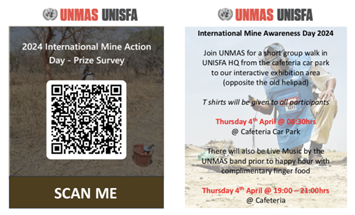
Abyei - On 4 April in Abyei, UNISFA set up an interactive exhibition area about the “Prize Survey” and invited the staff to the “Show and Tell” event. They will be presenting a skit on explosive ordnance risk education to raise awareness about the dangers of explosive ordnance. Additionally, there will be live music and an award ceremony to recognize the most meaningful answers to the “Prize Survey”.
Afghanistan - The IMAD commemorations in Afghanistan will be led by the Directorate for Mine Action Coordination (DMAC) and the mine action implementing partners on 4 April in Kabul. UNMAS Afghanistan and other key stakeholders will participate in the event. On the day around 100 deminers along with their technical equipment including (metal detectors, visors, and armor jackets) will be displayed/ paraded. There will also be an exhibition area for demining equipment, risk education and victim assistance. See how Sharafuddin, Team Leader at Halo Trust is working to demine Afghanistan for a safer tomorrow.
Colombia - On 3 April, UNMAS Colombia a panel discussion will be held from, 10am - 12pm at the Auditorio Marino Troncoso, Pontificia Universidad Javeriana, Bogotá; Join us for a conversation on 'Humanitarian Demining and Territorial Transformation: Contributing to the Construction of Peace from the Territories' organised by the High Commissioner for Peace. Get the flyer (in Spanish) and Register for the event.
Somalia; On April 6th, 2025, from 10am to 12pm at theTukul, UN Compound, Mogadishu. We invite you to join us in this important commemoration with remarks from key UN and Somali officials and presentations on the ongoing efforts to strengthen Somali-led mine action capabilities. You will have an opportunity to meet our wonderful explosive detection dogs and watch them go through their paces, as well as to familiarize yourself with the equipment and engage with technical experts to discuss all aspects of mine action in Somalia. Personnel from SNA and SPF will be present to participate in the interactive session for the EDD response Demo. Ethiopia - On 4 April, the United Nations in Ethiopia would like to stress the need for enhancing support to victims affected by Explosive Ordnance with a commemorative event in Addis Ababa, bringing together the United Nations, donors and members of the Mine Action community. Keynote speaker will be the director of the Ethiopian Mine Action Office, with further contributions by the UN Resident and Humanitarian Coordinator, the UNICEF Ethiopia Head and a representative of a local NGO involved in Mine Action in the country.
Democratic Republic of the Congo - On 4 April, UNMAS RDC partner with the Korean International Cooperation Agency (KOICA) and the Congolese Mine Action Coordination Center (CCLAM) to organize an event in Kinshasa, in recognition of mine action day. The event brought together important people and organizations, including donors, embassies, national authorities, and others to raise awareness about the dangers of landmines and explosive remnants of war.
Syria - The UNMAS team in Syria invited heads of agencies in Syria for a field visit to Yarmouk on Thursday 14th March (Yarmouk is a Palestinian refugee camp and was heavily affected by the crisis). The joint visit by UNMAS ,UNRWA and Norwegian People’s Aid (NPA) survey and clearance teams took place then.The event has been arranged to mark Mine Action Day. In cooperation with agencies including UNHCR, UNFPA, UNICEF, UNRWA, WHO, OSE, and OCHA, a series of joint media posts will be published to mark the day and raise awareness of affected populations. Furthermore, a joint initiative with UNICEF was organized to promote mine awareness through painting activity in two schools located in Rural Damascus. There was also an SMS awareness campaign to all mobile phone subscribers in the country, and a Facebook campaign to ensure the messages and visual contents reach beneficiaries. Additionally, official ceremony will be held on 16 April, an open-door afternoon at the UNMAS office in Damascus allowing visitors to learn about the organization’s demining operations in the country.
EXHIBITS: In the Washington D.C., United States, on April 7th 2025, from 6pm - 8pm at the Rayburn House Office Building; an Exhibition and Reception will be held to mark the day. You are cordially invited to join the bipartisan Congressional Unexploded Ordnance/Demining Caucus for an exhibition and reception to celebrate International Mine Awareness Day, and to acknowledge the United States' historical commitment to Conventional Weapons Destruction. Join us for an evening with refreshments, interactive exhibits from leading demining organizations, cutting edge technology from the Department of Defense (including Spot the robot dog), and demonstrations from live demining dogs and rats. Hear from Members of Congress (including Caucus Co-Chairs Reps. Chrissy Houlahan and David Valadao, and HFAC Chairman Brian Mast), Administration representatives, and Ambassadors about the modern field of humanitarian demining and how the United States is saving lives and strengthening security around the world. Get the flyer and Register to participate!
ACTIVITIES: Over the next week we will bring you more stories from the occupied Palestinian territories, Rwanda, Syria, Ukraine and elsewhere. “Leave no one behind”, the goal of the 2030 Agenda, and as disability rights activists have stated for decades, “Nothing about us, without us”.
EVENTS: On Wednesday, April 2nd from 10:00 a.m. - 1 p.m. EDT, the international community will gather to commemorate the World Autism Awareness Day 2025, under the theme "Advancing Neurodiversity and the UN Sustainable Development Goals (SDGs)",. Bringing together global experts, policymakers, and autistic voices, the event features keynote speeches, panel discussions, and interactive sessions, addressing areas such as inclusive healthcare, education, employment, and urban development. This year’s discussion will explore the role of neurodiversity in shaping policies that promote accessibility, equality, and innovation across multiple sectors. Discussions focus on inclusive healthcare, quality education, workplace accessibility, reducing inequalities, and designing autism-friendly cities and communities. The 2025 WAAD event is organized by the Institute of Neurodiversity (ION), with the support of the United Nations Department of Global Communications. ION is a neuro minority-founded and led global membership organization headquartered in Switzerland, with a presence in 40 countries worldwide. As the largest, most globally represented neurodiversity initiative, ION works to empower neuro-minorities, advocate for equal opportunities, and promote acceptance and education. By fostering dialogue and collaboration across multiple sectors, World Autism Awareness Day 2025 will reinforce the need for sustained efforts to eliminate barriers, promote inclusive policies, and recognize the contributions of autistic individuals to society and the achievement of the SDGs. Register to participate!