Showing posts with label Chernobyl Disaster Remembrance Day. Show all posts

Sunday, 26 April 2026

International Chernobyl Disaster Remembrance Day 2026; April 26th.

FORUM: "Reflecting on the tragedy'' International Chernobyl Disaster Remembrance Day 2026. Today mark the 40 years since the tragedy occurredThe chernobyl-disaster nuclear power incident remains a key to secure our clean energy future; There is still a great deal of work that needs to be done in the affected region. Follow the conservations with the hashtags:#Chernobyl, #minuteofsilence, #chernobyldisasterday, #26April.

April 26th

EVENTS:  40 years since the tragedy occurred.

At UNHQ; On Sunday April 26th; 2026; The General Assembly invites all Member States, relevant agencies of the United Nations system and other international organizations, as well as civil society, to pay a minute of silence. A Candle lighting ceremony will be held to mark the International Chernobyl Disaster Remembrance Day 2026. The Chernobyl disaster tragedy is not only a painful memory, but also an important lesson for future generations.


At UN Geneva, an commemorative event will mark the 40th anniversary of the Chornobyl disaster,which remains one of the most severe nuclear accidents in history. The explosion at the Chоrnobyl Nuclear Power Plant resulted in the release of significant amounts of radioactive material across large parts of Europe, resulting in profound human, environmental and socio-economic consequences. It caused immediate casualties and long-term health effects, including increased incidence of thyroid cancer. Large populations were displaced, and extensive areas were contaminated, with lasting impacts on ecosystems and livelihoods. Four decades after the disaster, there remains persistent serious long-term consequences and that the affected communities and territories are experiencing continuing related needs.

Statements and reactions from stakeholders from International Geneva include:
Statement by Special Rapporteurs on the 40th anniversary of the Chornobyl disaster in Ukraine | UN Special Rapporteur on toxics and human rights & UN Special Rapporteur on the right to a clean, healthy and sustainable environment | 23 April 2026
Chernobyl: 40 Years On | Green Cross Switzerland


40 years on, today reminds us of the lasting human and environmental impacts of nuclear disasters and our shared responsibility to protect people and the planet. Learn how to addresses nuclear risks & impacts.
 
On 26 April 2026 | starting at18:00 CEST, Join the commemorative event entitled Tchernobyl an 40 - Rassemlement Nucléaire? Non merci, Sortir du nucléaire Suisse Romande in Monument National, Promenade du Lac 2,


40 Years since the Chernobyl Accident


The Radioactive Decay of the Iron Curtain: Re-Examination of the Chernobyl Catastrophe in Comparative Perspective

CONFERENCE


An international conference took place on April 17–18, 2026, at New Bulgarian University, dedicated to examining the long-term consequences of the Chernobyl disaster. Researchers from Bulgaria, the United States, Ukraine, Poland, Italy, Ireland, Scotland, Hungary, and Switzerland attended the event.



The first day of the conference focused on the political, social, and health consequences of the Chernobyl disaster, as well as on the role of communist regimes and institutional responses. Particular attention was given to the demographic effects across Eastern Europe, disinformation and media coverage, and comparative analyses of state security services. Special emphasis was also placed on the Ukrainian perspective through historical and contemporary parallels (1986–2022), personal testimonies, and the theme of cultural memory, including books and documentary film.



The second day highlighted the environmental consequences of the disaster and the growing public sensitivity to these issues. Discussions addressed nuclear safety in times of peace and war, as well as the role of international regulation in managing nuclear risks. Additional themes included media responses in Central and Eastern Europe, youth perceptions and educational approaches, and the representation of Chernobyl in cinema and literature.



The conference reports are to be published in the new academic publication of NBU Acta Nova Humanistica by the end of 2026. You can check the participants and their topics here.



The conference concluded with a discussion and workshop featuring students from the ERUA university alliance. Participants explored various approaches to communicating the Chernobyl story to younger audiences, drawing on insights gained throughout the conference.



The workshop began with role-playing exercises, where students enacted crisis response scenarios based on assigned roles – including a parent, school principal, military officer, and education minister. This was followed by a discussion on the potential of documentary filmmaking to convey the tragedy and aftermath of the Chernobyl disaster.



In the final segment, students were divided into three groups and tasked with developing concepts for a documentary film, including designing promotional posters. Each group determined their own thematic emphasis for the film concept and sketched out their ideas for film posters.
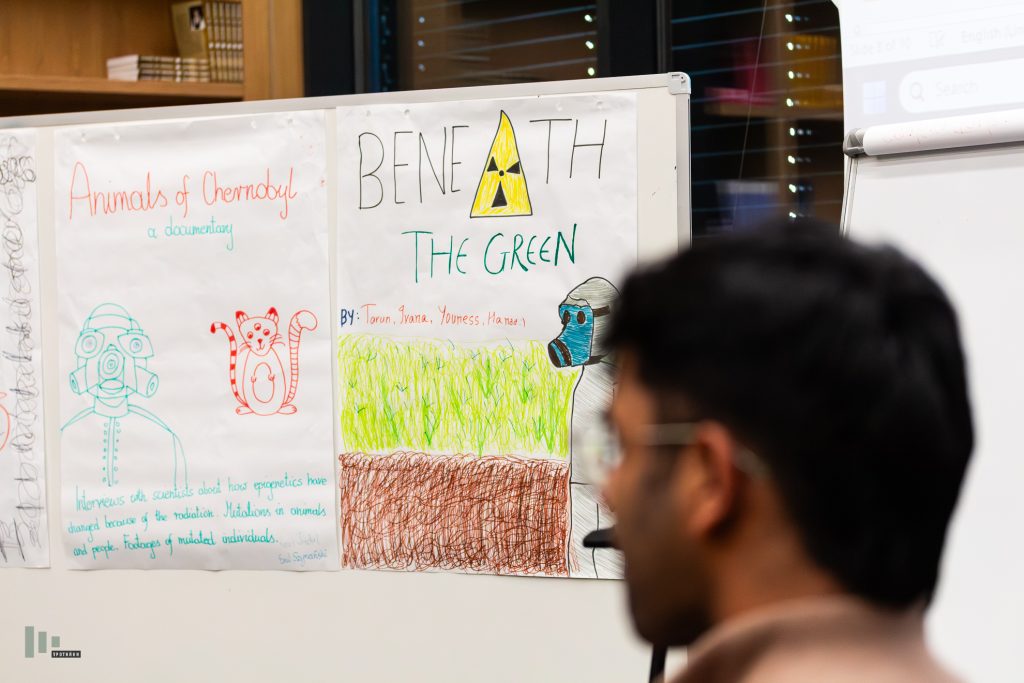


Here is what one of the participants wrote after the conference: I would like to express my sincere gratitude for the opportunity to participate in the conference at NBU. It was an exceptionally enriching experience. I was particularly impressed by the interdisciplinary nature of the discussions and the openness of all participants. The exchange of perspectives across different fields created a truly stimulating intellectual environment. I must admit that I had not expected an event so distant in time for some to still evoke such strong emotions and remain the subject of such extensive research – especially beyond Ukraine. This made the conference even more thought provoking and impactful.


Saturday, 26 April 2025

International Chernobyl Disaster Remembrance Day 2025; April 26th.

April 26th.


FORUM:39 years since the tragedy occurred.International Chernobyl Disaster Remembrance Day 2025. It is normal for people to seek an explanation for why the tragedy occurred. Through understanding, we seek to reassure ourselves that a similar event could happen again. Learn about the world's worst nuclear disaster that happened at Chernobyl by exploring the timeline of Events.

On April 25th, 1986, 1 a.m. - Chernobyl’s operators begin reducing power at reactor No. 4 in preparation for a safety test, which they have timed to coincide with a routine shutdown for maintenance. The test is supposed to determine whether, in the event of a power failure, the plant’s still-spinning turbines can produce enough electricity to keep coolant pumps running during the brief gap before the emergency generators kick in. Ironically, this safety test brings about the reactor’s destruction.
  • On April 25th, 1986, 2 p.m. - Reactor No. 4’s emergency core cooling system is disabled to keep it from interfering with the test. Though this doesn’t cause the accident, it worsens the impact. At around the same time, the test and shutdown are temporarily delayed to accommodate the region’s power needs.
  • On April 25, 1986, 11:10 p.m. - Operators receive permission to continue with the test and shutdown. By now, the less-experienced night shift is on the job, which purportedly never received proper instructions on how to perform the test.
  • On April 26th, 1986, 12:28 a.m. - Power plummets to far below the level at which the reactor is considered stable. Operators respond by removing most of the control rods in violation of the plant’s safety guidelines, yet they still have trouble raising the power, in part due to xenon buildup in the core.
  • On April 26th, 1986, 1 a.m. - The power stabilizes, albeit at a lower than preferred level, and plant supervisors order the test to proceed. The automatic emergency shutdown system and other safety features are subsequently turned off.
  • On April 26th, 1986, 1:23:04 a.m. - The test officially begins, and an unexpected power surge occurs.
  • On April 26th, 1986, 1:23:40 a.m. - An operator presses the emergency shutdown button, but the control rods jam as they enter the core.
  • On April 26th, 1986, 1:23:58 a.m. - The first explosion, to be quickly followed by at least one more, blows the 1,000-ton roof right off the reactor and shoots a fireball high into the night sky. A blackout roils the plant as the air fills with dust and graphite chunks, and radiation begins spewing out. Walls and equipment collapse, and dozens of fires start up, including one on top of the neighboring reactor. Despite all evidence to the contrary, the nuclear engineer in charge of the test insists that reactor No. 4 is still intact. He later dies of radiation poisoning.
  • On April 26th, 1986, 1:28 a.m. - The first firefighters arrive at the scene. They have no knowledge of the radiation and wear no protective clothing.
  • On April 26th, 1986, 2:15 a.m. - Local Soviet officials convene an emergency meeting at which they decide to block cars from exiting or entering Pripyat, a nearby city that was built to house Chernobyl’s workers. Police officers assisting with the roadblock likewise have no knowledge of the radiation and wear no protective clothing.
  • On April 26th, 1986, 5 a.m. - Officials shut down reactor No. 3, to be followed the next morning by reactor Nos. 1 and 2. They are re-opened months later.
  • On April 26th, 1986, 6:35 a.m. - By now, all fires have been extinguished except for a blaze in the reactor core, which will burn for days.
  • On April 27th, 1986, 10 a.m. - Helicopters begin dumping sand, clay, boron, lead and dolomite into the burning core in an attempt to slow radioactive emissions.
  • On April 27th, 1986: 2 p.m. - After telling residents nothing about the disaster for some 36 hours, Soviet officials finally begin evacuating roughly 115,000 people from Pripyat, as well as nearby towns and villages. Residents are informed it will be temporary and that they should pack only vital documents and belongings, plus some food. Soon after, however, an exclusion zone is set up around Chernobyl that prevents their return.
  • On April 28th, 1986 - Swedish air monitors detect a large amount of radiation in the atmosphere, which is traced back to the USSR. Soviet officials admit that there’s been an accident, but they falsely state the situation is under control.
  • On April 29th, 1986 - Spy satellite photos provide U.S. officials with their first glimpse of the devastation wrought by the Chernobyl disaster.
  • On May 1, 1986 - Soviet officials refuse to cancel the May Day festivities in Kiev, even as radiation continues to be released unabated.
  • On May 4th, 1986 - Liquid nitrogen is pumped underneath the dead reactor in order to cool it. Other aspects of the cleanup, which involves up to 800,000 workers, include bulldozing contaminated villages, shooting contaminated pets and livestock, and burying huge amounts of contaminated topsoil.
  • On May 6th, 1986 - Radioactive emissions drop sharply, possibly because the fire in the core has burned itself out. Meanwhile, Soviet officials finally close schools in Kiev and advise residents to stay inside and to not eat leafy vegetables.
  • On May 8th, 1986 - Workers finish draining about 20,000 tons of radioactive water from the basement under the core.
  • On May 9th, 1986 - Workers begin pouring concrete under the reactor, which is later encased in an enormous concrete and metal structure known as the sarcophagus.
  • On May 14th, 1986 - Soviet leader Mikhail Gorbachev speaks publicly about the incident for the first time, saying on state TV that "the worst is behind us."
  • On August 25-29, 1986 - The International Atomic Energy Agency hosts a conference at which scientists blame the accident not just on human error and a subpar safety culture, but also on Soviet reactor design flaws.
  • On December 15, 2000 - Unit 3, the last working reactor at Chernobyl, is shut down. Units 1 and 2 had been shut down in 1996 and 1991, respectively.
  • On April 2006 - President Gorbachev writes that the Chernobyl disaster, "even more than my launch of perestroika, was perhaps the real cause of the collapse of the Soviet Union.

Since the United Nations agencies have shifted their focus from humanitarian assistance to prevention, recovery, remediation and capacity development, an integrated approach to sustainable development was adopted to address the needs of the affected regions and communities. Follow the conservations with the hashtags:#Chernobyl, #minuteofsilence, #chernobyldisasterday, #26April.

EVENTS: Minutes of silence for the victims of the Chernobyl nuclear disaster. On April 26th at 1:23:58 a.m GMT for International Chernobyl Disaster Remembrance Day 2025; The United Nations General Assembly invites all Member States, relevant agencies of the United Nations system and other international organizations, as well as civil society to observe the day. This year, we commemorate the 39th observance of the tragedy; Participants will pay a minute of silence to the victims during the candle lighting ceremony, The survivors and dignitaries later will mark the day with a night vigil.


Friday, 26 April 2024

International Chernobyl Disaster Remembrance Day 2024; April 26th.


FORUM: “38 years since the tragedy occurred.International Chernobyl Disaster Remembrance Day 2024. It is normal for people to seek an explanation for why the tragedy occurred. Through understanding, we seek to reassure ourselves that a similar event could happen again. Learn about the world's worst nuclear disaster that happened at Chernobyl by exploring the timeline of Events. Since the United Nations agencies have shifted their focus from humanitarian assistance to prevention, recovery, remediation and capacity development, an integrated approach to sustainable development was adopted to address the needs of the affected regions and communities. Follow the conservations with the hashtags:#Chernobyl, #minuteofsilence, #chernobyldisasterday, #26April.

International Chernobyl Disaster Remembrance Day 2024


EVENTS: Minutes of silence for the victims of the Chernobyl nuclear disaster. On April 26th at 01:23:58 a.m GMT for International Chernobyl Disaster Remembrance Day 2024; The United Nations General Assembly invites all Member States, relevant agencies of the United Nations system and other international organizations, as well as civil society to observe the day. This year, we commemorate the 38th observance of the tragedy; Participants will be invited to pay a minute of silence to the victims during the candle lighting ceremony, The survivors and dignitaries later will mark the day with a night vigil.


A liquidator of the Chernobyl catastrophe lays flowers below a bust at 'The Heroes Alley' in memory of the Chernobyl victims.

Ukrainian government and administrator layed flowers below a bust at 'The Heroes Alley' in memory of the victims of the 1986 Chernobyl disaster in Kiev.

Widows holding portraits of their husbands who died following the liquidation after the Chernobyl catastrophe during a memorial ceremony.

Young peoples hold candles during a mourning ceremony near of the memorial for 'liquidators' who died during cleaning up works after the Chernobyl nuclear power plant disaster, in Slavutich, Ukraine.

Families arranges portraits of lost liquidators near a monument honoring people who were killed in cleanup efforts after the Chernobyl nuclear power plant disaster.

Citizen stands near the monument erected in memory of the victims of the Chernobyl explosion in Ukraine's capital Kiev, Ukraine, on April 26

A emotional reactions at the monument honoring people who were killed in cleanup efforts after the Chernobyl nuclear power plant disaster during a memorial ceremony in Kiev.

In Russia and Belarus, the participants have observed a munite of silence on hehalf the 38th observance of the tragedy.